Limba Noastră: the day a country took back its alphabet
Most national days commemorate a battle or a treaty. Moldova has one that commemorates an alphabet.
By Pierre CalitzPolokwane31 August 2026
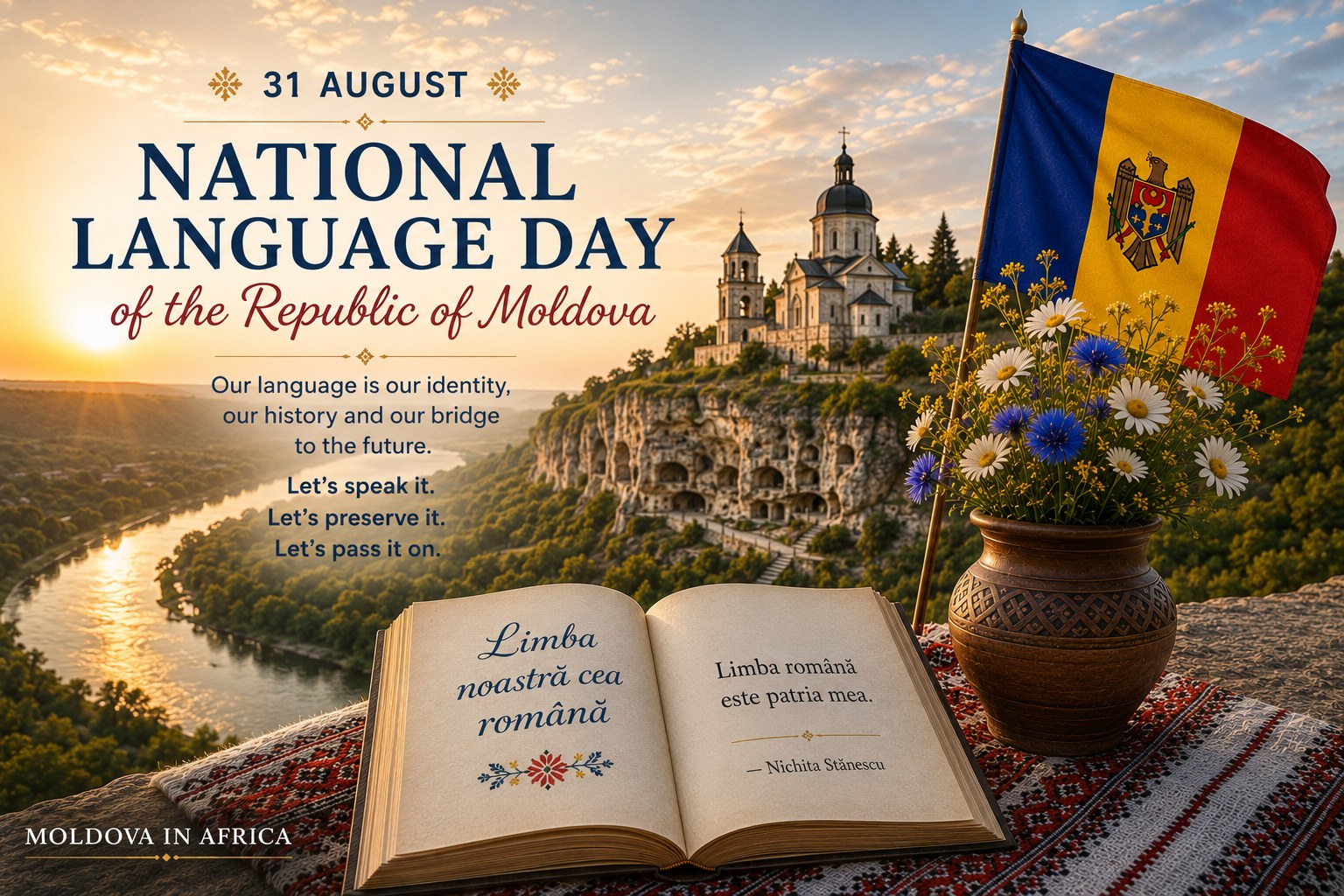
Orheiul Vechi, above the Răut. Quotation: Nichita Stănescu.
On 27 August 1989, around 750,000 people gathered in Chișinău for what became known as the Great National Assembly. The population of the Moldavian Soviet Socialist Republic at the time was roughly four and a half million.
Something close to one person in six was in that square.
Four days later, on 31 August, the republic’s legislature passed two laws. The first made the language spoken by the majority the state language. The second returned it to the Latin alphabet. Both anniversaries are still marked; the second is a public holiday.
There is a detail that belongs in this story and is usually told separately from it. In 1917, at the Congress of Teachers of Bessarabia, a young priest named Alexei Mateevici read out a poem he had written called Limba noastră. Our language. It opens by calling the language a treasure buried deep, a string of rare stones spilled across the homeland. That poem is now the national anthem of the Republic of Moldova.
The congress at which he read it was the congress that voted for the Latin alphabet.
Under Soviet administration the language of Moldova had been written in Cyrillic and officially designated something separate from Romanian. The script was the instrument. Change the letters a people write in, and you change what they can read, who they can read, and where they belong.
The 1989 laws reversed the script. The question of the name took considerably longer. Not until 2023, by Law 52, was the phrase “Moldovan language” replaced with “Romanian language” throughout the legislation of the Republic. Thirty-four years between the alphabet and the name.
Where a crowd once stood in the street demanding the Latin alphabet, thousands now sit at desks and write in it.
That is roughly what happened in the same square on Monday morning.
The fourth edition of the National Dictation was held in the Great National Assembly Square, organised by the Ministry of Education and Research under the aegis of the Presidency. Registration opened at half past seven. Around 2,500 people wrote in the square itself, seated two to a desk, with a further thousand taking part from districts across the country. More than three thousand had registered in advance, the highest number since the competition began in 2023. For the first time, the dictation was adapted for participants with visual impairments.
The Minister of Education and Research, Dan Perciun, told those present that what was being celebrated had not arrived on its own. It was the result of what earlier generations had done.
President Maia Sandu’s message made the same point differently. Parents and grandparents kept speaking the language through prohibition and humiliation, she said, and it can now be spoken freely, without fear. She framed that freedom as an obligation to pass on rather than a possession to enjoy.
Three countries, for the first time
Moldova has marked 31 August since 1990. Romania joined in 2013. In 2026, for the first time, Ukraine marks it too, in recognition of its Romanian-speaking community.
Three states, one date, one language. For a country of 2.4 million negotiating accession to a Union where Romanian is already an official language, that is not a sentimental fact. It is an asset, and Moldova knows it.
There is no obvious reason a reader in Polokwane or Nairobi would know any of this. But the shape of the story is not unfamiliar on this continent. South Africa recognises twelve official languages, and it does so because the question of which language a country conducts itself in was never a neutral one here either. A generation of South Africans can tell you precisely what was at stake when a state decided which language its children would be taught in.
Moldova had to legislate its own alphabet back into existence. That is a story this continent can read without translation. ◆
Pierre Calitz
Founder, Moldova in Africa Polokwane, South Africa
Reported from Africa
Sources: Ministry of Education and Research of the Republic of Moldova; Presidency of the Republic of Moldova; MOLDPRES; NewsMaker; Realitatea.md. Historical detail on the events of August 1989 and Law 52/2023 from published Moldovan legislative record.
Moldova in Africa is an independent public diplomacy platform introducing the Republic of Moldova — its culture, history, language and European integration — to audiences across the African continent. It is not affiliated with, endorsed by, or acting on behalf of the Government of the Republic of Moldova.
Cultură și patrimoniu
Limba noastră: ziua în care o țară și-a recuperat alfabetul
Majoritatea zilelor naționale comemorează o bătălie sau un tratat. Moldova are una care comemorează un alfabet.
De Pierre CalitzPolokwane31 august 2026
Orheiul Vechi, above the Răut. Quotation: Nichita Stănescu.
La 27 august 1989, aproximativ 750.000 de oameni s-au adunat la Chișinău la ceea ce avea să fie cunoscut drept Marea Adunare Națională. Populația Republicii Sovietice Socialiste Moldovenești era atunci de circa patru milioane și jumătate.
Aproape o persoană din șase se afla în acea piață.
Patru zile mai târziu, la 31 august, legislativul republicii a adoptat două legi. Prima a făcut din limba vorbită de majoritate limbă de stat. A doua a readus alfabetul latin. Ambele aniversari sunt încă marcate; a doua este zi de sărbătoare națională.
Există un detaliu care aparține acestei povești și care se povestește de obicei separat. În 1917, la Congresul învățătorilor din Basarabia, un tânăr preot pe nume Alexei Mateevici a citit o poezie pe care o scrisese, intitulată Limba noastră. Poezia începe numind limba o comoară în adâncuri înfundată, un șirag de piatră rară pe moșie revărsată. Este astăzi imnul de stat al Republicii Moldova.
Congresul la care a citit-o a fost congresul care a votat pentru alfabetul latin.
Sub administrația sovietică, limba din Moldova fusese scrisă cu caractere chirilice și desemnată oficial drept ceva distinct de română. Grafia era instrumentul. Schimbi literele în care scrie un popor și schimbi ce poate citi, pe cine poate citi și unde aparține.
Legile din 1989 au inversat grafia. Chestiunea denumirii a durat considerabil mai mult. Abia în 2023, prin Legea 52, sintagma „limba moldovenească” a fost înlocuită cu „limba română” în toată legislația Republicii. Treizeci și patru de ani între alfabet și nume.
Acolo unde o mulțime stătea odată în stradă cerând alfabetul latin, mii de oameni stau astăzi la mese și scriu în el.
Cam asta s-a întâmplat în aceeași piață luni dimineața.
A patra ediție a Marii Dictări Naționale a avut loc în Piața Marii Adunări Naționale, organizată de Ministerul Educației și Cercetării sub egida Președinției. Înregistrarea a început la ora 07:30. Aproximativ 2.500 de persoane au scris în piață, câte două în bancă, iar alte o mie au participat din raioanele țării. Peste trei mii se înscriseseră în prealabil, cel mai mare număr de la lansarea competiției în 2023. În premieră, dictarea a fost adaptată pentru participanții cu deficiențe de vedere.
Ministrul Educației și Cercetării, Dan Perciun, le-a amintit celor prezenți că ceea ce se sărbătorește nu a venit de la sine. Este rezultatul a ceea ce au făcut generațiile anterioare.
Mesajul Președintei Maia Sandu a spus același lucru altfel. Părinții și bunicii au continuat să vorbească limba în ciuda interdicțiilor și umilințelor, iar astăzi poate fi vorbită liber, fără teamă. A prezentat această libertate ca pe o datorie de transmis mai departe, nu ca pe o posesie.
Trei țări, pentru prima dată
Moldova marchează ziua de 31 august din 1990. România s-a alăturat în 2013. În 2026, pentru prima dată, o marchează și Ucraina, în considerarea comunității sale vorbitoare de limba română.
Trei state, o dată, o limbă. Pentru o țară de 2,4 milioane de locuitori care negociază aderarea la o Uniune unde româna este deja limbă oficială, acesta nu este un fapt sentimental. Este un atu, și Moldova știe asta.
Nu există un motiv evident pentru care un cititor din Polokwane sau Nairobi ar ști ceva din toate acestea. Dar forma poveștii nu este străină pe acest continent. Africa de Sud recunoaște douăsprezece limbi oficiale, și o face pentru că întrebarea în ce limbă funcționează o țară nu a fost niciodată neutră nici aici. O întreagă generație de sud-africani poate spune exact ce era în joc atunci când un stat a decis în ce limbă vor fi învățați copiii săi.
Moldova a trebuit să-și legifereze alfabetul înapoi în existență. Este o poveste pe care acest continent o poate citi fără traducere. ◆
Pierre Calitz
Fondator, Moldova in Africa Polokwane, Africa de Sud
Relatat din Africa
Surse: Ministerul Educației și Cercetării al Republicii Moldova; Președinția Republicii Moldova; MOLDPRES; NewsMaker; Realitatea.md. Detaliile istorice privind evenimentele din august 1989 și Legea 52/2023 provin din registrul legislativ publicat al Republicii Moldova.
Moldova in Africa este o platformă independentă de diplomație publică, care prezintă Republica Moldova — cultura, istoria, limba și integrarea sa europeană — publicului de pe continentul african. Platforma nu este afiliată Guvernului Republicii Moldova, nu este susținută de acesta și nu acționează în numele său.